
A Song-Based Approach That Works
Wondering how to teach intervals in elementary music in a way that truly connects with students? At Creative Music Room, we believe the answer is through song.
Intervals are the building blocks of melody and in the elementary music classroom, they can also be moments of magic. Whether it’s the small step of a second or the wide-open space of a seventh, each interval has a unique sound, and our songs help students experience that sound in a joyful, memorable way.
It’s Never Too Early to Teach Intervals
You don’t have to wait until upper elementary to start exploring intervals. With the right approach, even your youngest students can begin to feel and recognize the space between notes. The key is to keep it playful and relatable. For example, when introducing the interval of an octave, I ask: “How many legs does an octopus have?” When they shout, “Eight!” I follow with, “Well, an octave has eight notes, too!” Making these connections early helps students internalize musical concepts with curiosity and confidence.
Why Teach Intervals Through Song?
Teaching intervals through singing helps students develop aural skills, pitch recognition, and music reading confidence. Instead of labeling intervals as “just skips or steps,” students hear what a third feels like and remember the sound of a fourth because it lives in a melody they may already know.
Using interval songs in the elementary music classroom supports:
- Ear training and pitch matching
- Music literacy and note reading
- Musical expression through vocal work
- Creative composition and improvisation
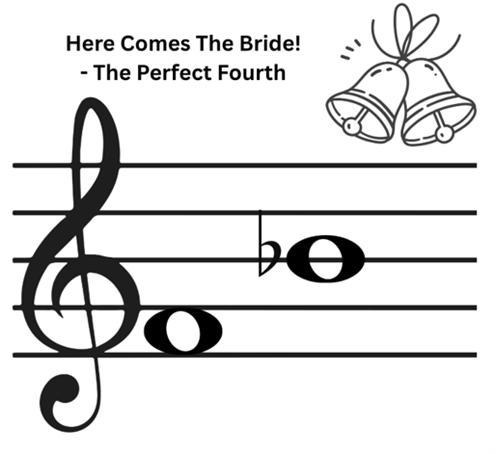
When introducing intervals in elementary music, it’s often helpful to anchor each one to a familiar melody. These well-known songs are great for helping students internalize the sound and feel of each interval:
- Second: “Row, Row, Row Your Boat” – “Row, row” = major second
- Third: “When the Saints Go Marching In” – “Oh when” = major third
- Fourth: “Here Comes the Bride” – iconic ascending perfect fourth
- Fifth: “Twinkle, Twinkle Little Star” – “Twin-kle, twin-kle” – perfect fifth
- Sixth: “My Bonnie Lies Over the Ocean” – “My Bon” = major sixth
- Seventh: “Somewhere” (West Side Story) – “There’s a place…” = ascending minor seventh
- Octave: “Somewhere Over the Rainbow” – “Some-where” = ascending octave
These melodies are familiar to many students and serve as helpful references as they begin to explore the distances between notes.
Want to Take It Further? Try Our Interval Songs
At Creative Music Room, we’ve developed our own collection of original interval songs that students absolutely love. Some are tongue twisters, some are silly and playful, and others are sweet, lilting melodies that invite reflection and calm. Each one is crafted to help young musicians feel the shape of a melody and hear how intervals build music.
Here are the songs in our collection:
- Can You Hear the Steps? A fun, energetic song for learning seconds, with a built-in tongue twister students love to speed up.
- Skipping a Third. A gentle introduction to thirds, with playful melodic movement.
- “Here Comes the Bride.” A creative spin on the familiar fourth, tying in imagery and phrasing.
- The Wonderful Fifth. Captures the bold, open sound of the perfect fifth.
- Stuck on a Sixth. A funny, expressive song built around the phrase “Oh, no!”—perfect for bringing the sixth interval to life.
- Flying with a Major Seventh. Light, flowing, and full of tension—this one’s ideal for more advanced ears.
- Eight Steps You Will See. Highlights the octave in a calm, stepwise ascent.
- A Chromatic Melody. A challenge song that explores half steps and nuance with care and clarity.
How to Use These Interval Songs in Class
- Warm-up activities. Use songs like Can You Hear the Steps? at the start of class to center students and focus their listening.
- Melodic dictation practice. After singing, have students notate the intervals using solfege or letter names.
- Echo singing. Break songs into phrases and let students echo back specific intervals to reinforce aural memory.
- Creative response. Have students create movement, gestures, or drawings that represent each interval’s shape or feeling.
- Build toward composition. Once students are confident, use these songs as models to inspire their own interval-based melodies.
Why Teaching Intervals Matters
When we teach intervals through song, we give students tools they’ll carry into everything. I use it as a launching pad to encourage sight-singing, composition and even instrumental work.
If you’re looking for elementary music lesson plans that support aural development, literacy, and joyful music-making, our interval song collection is a great place to start.
Explore all our interval songs for elementary students, and let your students take their own big leaps—one musical step at a time.